At the end of that conversation, they said something that changed everything:
“We have an old 1986 Sivetz fluid bed roaster in storage. If you pay for shipping, you can have it.”
I was on cloud nine.
That machine represented history. Fluid-bed roasting. Airflow precision. The science of heat transfer. It
felt like an invitation into a deeper world.
But just a few days later, my wife and I were dreaming out loud about what this could become.
She smiled and said, “This will be great. I can roast coffee while you’re out selling real estate.”
My mind came to a screeching halt.
I love my wife. She is an extraordinary cook — creative, intuitive, artistic. She adds a pinch of this and a dash of that until the masterpiece comes together. She avoids recipes like the plague.
But roasting coffee isn’t cooking.
It’s baking. And baking is chemistry.
If you let a roast run three seconds too long, it is a different product.
In business, consistency builds trust. And trust builds a tribe of people willing to pay for your work again and again.
So I told her — gently but honestly — that roasting required a level of precision and repeatability that couldn’t rely on instinct alone.
I felt terrible deflating her excitement. But that moment clarified something for both of us.
If this was going to work, it couldn’t depend on guesswork.
It needed precision.
At first, I tried to engineer my way around the problem.
I looked into building a smaller version of the Sivetz on my porch.
I researched Cropster and Artisan software.
I studied automation systems from other manufacturers.
Then my wife sat me down and reminded me of something I needed to hear:
“You are not an engineer. And most of your DIY projects are half finished.”
She wasn’t wrong.
We make a great team — not because we flatter each other’s dreams, but because we reflect reality
back to one another. Sometimes partnership is encouragement. Sometimes it’s clarity.
That clarity shifted my search.
I wasn’t looking for the biggest roaster.
I wasn’t looking for the cheapest roaster.
I was looking for a machine that could:
- Replicate roast profiles consistently
- Allow small-batch experimentation
- Operate efficiently
- Deliver scientific precision without me becoming an engineer
I wasn’t even sure that machine existed.
Then I stumbled across a company in Taiwan called Rubasse.
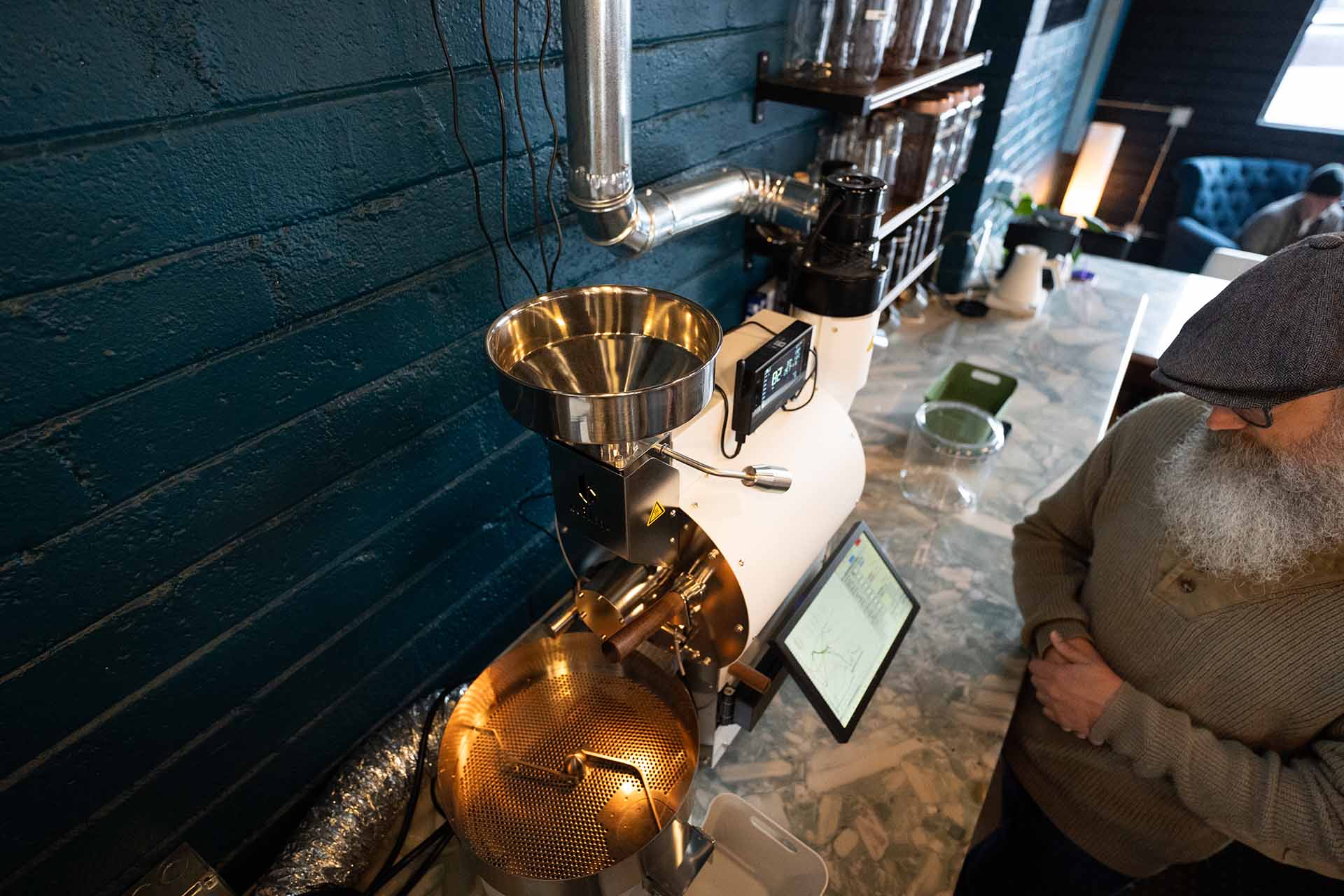
The name comes from a rare ruby-colored facet found in quartz crystal — and that detail matters. Because Rubasse developed a roasting system using Near Infrared (NIR) heat, part of the light spectrum that requires quartz crystal lenses to transmit energy effectively.
This wasn’t just a drum and flame.
It was engineered heat transfer.
And the numbers stunned me.
On average, the Rubasse system uses about 1 kilowatt-hour of energy to roast five pounds of coffee.
For perspective: I had recently sat through a presentation from the CEO of a major American roasting manufacturer explaining why electric roasters weren’t greener or more efficient than gas.
After his presentation, I asked him directly: “What’s the solution?”
He said he wasn’t aware of one — now or in development.
I bit my lip.
Because I already had one in mind.
At the time, only two Rubasse machines existed in the United States.
Sending a significant wire transfer 7,000 miles overseas to a company with no U.S. presence was not comfortable.
There are scams everywhere.
There are horror stories everywhere.
I am not naive about risk.
Rubasse connected me with the owner of one of the two U.S. machines — a roaster in Maine. I called him the next day. He walked me through his experience, the support he received, and the reliability of the system.
He calmed my fears.
Eventually, I wired the money.
But I wasn’t going to inspect my machine over Google Meet.
My wife and I looked at each other and asked, “What’s stopping you from going to Taiwan?”
So I went.
Walking into Rubasse headquarters in Taipei changed everything.
I saw engineering discipline.
I saw attention to detail.
I saw humility.
And I saw a company that had quietly built what I believed were “Rolex-level” roasting machines — without marketing fanfare in the United States.
When I asked them why they hadn’t pursued the U.S. market, they shrugged. They were busy serving Asia. There had been no need to expand.
That moment shifted me from customer to connector.
If this technology existed…
And American roasters didn’t know about it…
Then someone needed to bridge the gap.
While in Taiwan, I ordered my second machine — the Rubasse Hyper 1.2kg — released that same week at the Taiwan International Coffee Show.
And I asked what it would take to become a U.S. importer.
I left Taiwan not just launching a roastery.
I left launching an equipment company.
Because sometimes life expands faster than you planned — when clarity, partnership, and conviction align.